Newsletter Subscribe
Enter your email address below and subscribe to our newsletter
Enter your email address below and subscribe to our newsletter

 ByJohn A
A practice manager gets a call from the front desk on a Tuesday. Dr. Patel is leaving the practice at the end of the month, and there are still two boxes of her cards in the supply closet. This is the moment every multi-provider clinic eventually runs into, and it is where the real cost of printed cards shows up, not on the invoice from the print run itself.
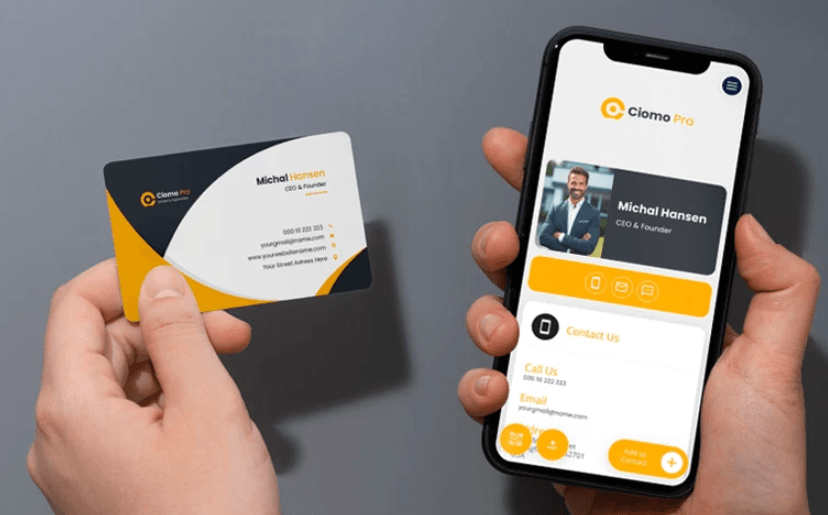
A digital business card for medical practice use removes this problem at its root, since the card content updates directly instead of requiring a new order every time something changes.
Vistaprint healthcare business cards look inexpensive per unit, and for a single provider who never changes anything, that pricing holds up fine. The math falls apart for a multi-provider clinic, where staff changes, panel updates, and location shifts happen often enough that reorders become routine rather than rare.
Each reorder covers the same fixed cost again: design time, shipping, and a waiting period before new cards actually arrive. A clinic that reorders three or four times a year is not really saving money against a digital option, even though the per-card number on the original invoice still looks smaller.
Three things tend to force a reprint in almost every practice.
A provider leaves or joins. A referral coordinator changes their extension. An insurance accepted list updates after a panel renegotiation. Any one of these makes every card printed before that date technically inaccurate, and patients or referring offices have no way of knowing the card in their hand is out of date.
A dentist digital business card avoids this because the update happens once, on the card’s linked page, and every existing card reflects it immediately. Nobody needs to know which batch of cards is current and which one belongs in the recycling bin.
The mechanism is simple. A QR code or NFC tap on the card opens a linked page rather than printing information directly onto cardstock. Updating that page updates what every scan shows, going forward, without touching the physical card at all.
This is what makes an appointment booking QR code useful beyond a one-time scan. If the scheduling system changes, or a specific booking link needs updating, the card stays exactly the same while the destination behind it changes.
A practice website link works the same way. If the practice moves to a new site or updates its homepage structure, the card still points to the right place because the link destination lives on the server side, not on the printed card.
Digital business cards for medical practices are built around this exact workflow, so a practice manager updates information once and does not need to track which printed batch is still accurate.
Clinic staff business cards turn over faster than provider cards do. A front-desk staff card gets handed out at insurance verification calls, community events, and patient checkout, and staff in these roles change shifts and titles more often than physicians do.
HIPAA-friendly contact sharing matters here too, since these cards typically carry standard contact and scheduling details rather than anything protected. That keeps the sharing simple for staff who hand out cards without needing to think about compliance every time.
Healthcare marketing efforts often assume printed materials stay accurate for as long as they are in circulation, and that assumption breaks down the moment a clinic grows or restructures. Patient intake improves when the first card a patient receives still has correct information six months later, not just on the day it was handed out.
This matters just as much for physician networking at referral events, where a card that still points to a working scheduling link months later reflects better on the practice than one that quietly stopped being accurate.
See also: Direct Flights from Newark to India: Best Nonstop Routes and Travel Tips
A single-provider practice with no staff turnover and a stable insurance panel will not feel this problem the way a larger clinic does. For that kind of practice, a bulk Vistaprint order is a reasonable, low-effort choice. The issue only shows up once a practice starts changing, which most multi-provider clinics do more often than they plan for.
Vistaprint sells a fixed print run that becomes outdated the moment anything changes. A digital business card for medical practice sells an update that applies to every card already in circulation. For a clinic that adds providers, updates insurance panels, or reassigns staff more than once a year, that difference adds up to real time and cost saved, well before the first reorder would have been due anyway.
What actually happens to old cards when a provider leaves the practice?
Nothing needs to happen to the physical card. The linked page can be updated or redirected, so the card in circulation no longer points to outdated information.
Does updating a card require any design or reprinting work?
No. The update happens on the linked page behind the QR code or NFC tap, so the physical card design stays the same while the content behind it changes.
How fast does an update apply across cards already handed out?
The update applies immediately once the linked page changes, since every scan pulls the current version rather than a fixed printed copy.
Is this still practical for a small solo practice with low staff turnover?
It can be, but the cost advantage is smaller for a practice that rarely changes anything. The benefit grows with the number of providers and staff changes.
Can a clinic switch its scheduling system without changing every card?
Yes. Since the booking link lives on the linked page rather than the card itself, switching systems only requires updating that one destination.